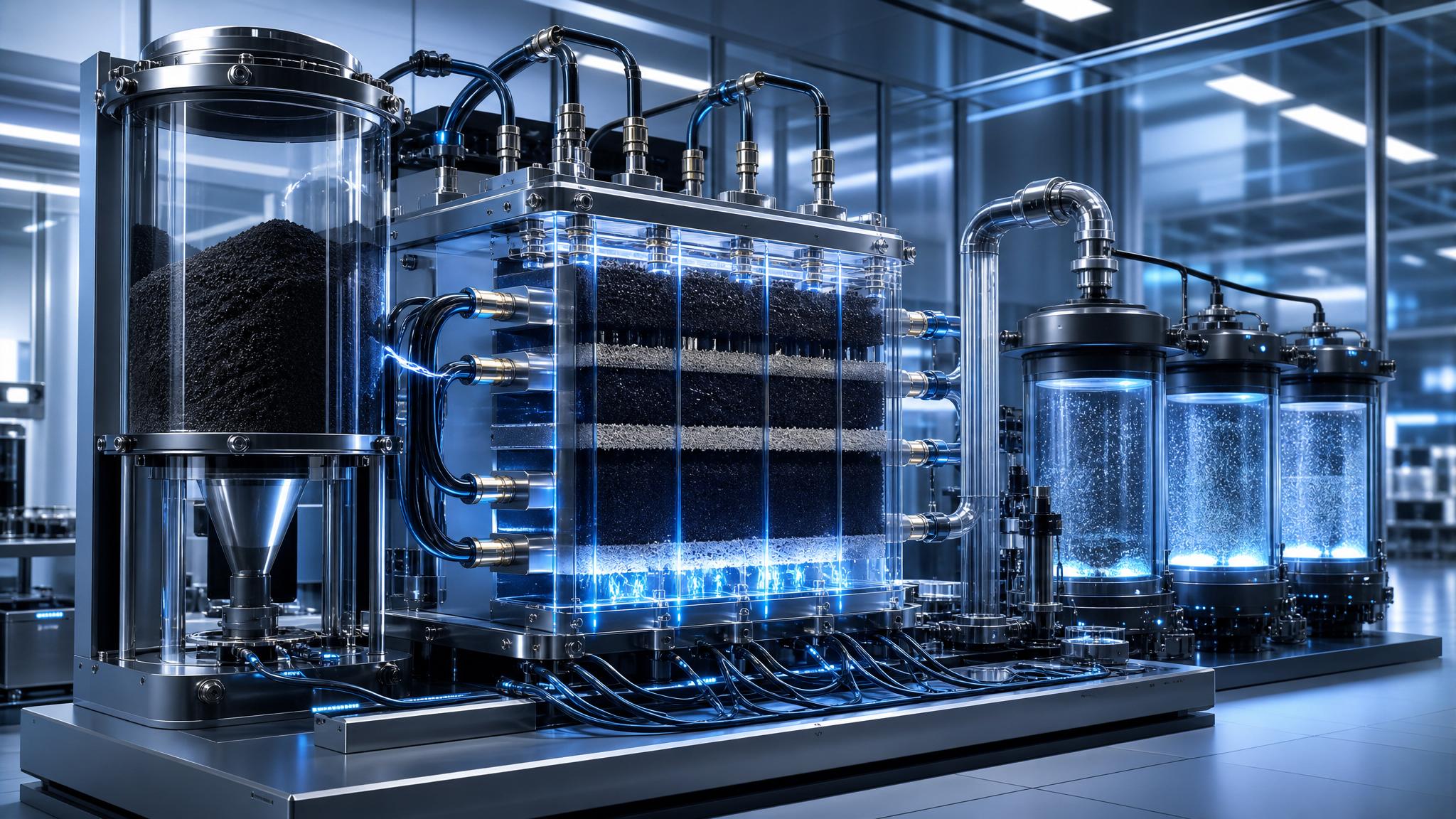
Short answer: the research claim is credible as an emerging energy-technology direction. Coal is not burned in the traditional boiler-and-steam-turbine sense. But coal still contains carbon, and carbon dioxide is still produced. The important question is whether that CO2 can be captured, converted or mineralised reliably at scale.
What has been reported?
A Chinese research team led by Xie Heping at Shenzhen University has described a system called a zero-carbon-emission direct coal fuel cell, or ZC-DCFC. Reports citing the South China Morning Post and the journal Energy Reviews say the system converts the chemical energy in coal directly into electricity through an electrochemical reaction.
That matters because a normal coal-fired power plant first burns coal to make heat, then uses that heat to make steam, and then uses the steam to turn a turbine. A fuel cell skips much of that thermal chain.
How the system is supposed to work
The coal is not simply dropped into a machine as raw lumps. It is pulverised into fine powder, dried, purified and chemically pre-treated so that it can react more efficiently inside the fuel cell.
The treated coal enters the anode chamber. Oxygen is supplied to the cathode side. Inside the cell, the coal undergoes electrochemical oxidation across an oxide membrane. In plain English: the fuel cell tries to turn coal’s stored chemical energy directly into electricity, without open flames, boilers, steam cycles or mechanical turbines.
| Conventional coal plant | Direct coal fuel cell concept |
|---|---|
| Burn coal to create heat | Electrochemically oxidise treated coal powder |
| Use heat to produce steam | No conventional steam cycle |
| Steam spins a turbine | Electricity is generated inside the cell |
| CO2 is mixed into flue gas | CO2 is generated in a more controlled outlet stream |
The key caveat: “zero emissions” does not mean carbon disappears
This is where the headline can become misleading. The process still uses coal. Coal is carbon-rich. When that carbon is oxidised, carbon dioxide is produced.
The reported advantage is that the CO2 is captured directly at the anode outlet, where it is more concentrated and easier to handle than ordinary smokestack exhaust. It can then be converted into chemical feedstocks such as synthesis gas, or mineralised into compounds such as sodium bicarbonate.
So the careful wording is not “coal power with no carbon at all”. A more accurate phrase is: electricity from coal without conventional combustion and with no direct CO2 release, if the carbon-capture and conversion loop works as described.
Why researchers are interested
Direct coal fuel cells have been studied for years because they could theoretically convert fuel into electricity more efficiently than a heat engine. Conventional coal plants are limited by the losses of combustion, steam production and turbine conversion. Some reports cite a theoretical efficiency target of around 80% for the new system, compared with roughly 40% for many conventional thermal coal plants.
That number should be treated as a research target, not a guaranteed commercial result. Real-world performance depends on durability, stack design, fuel preparation, contamination control, continuous fuel feeding and long-term operation.
What remains unproven
- Commercial scale: a laboratory or pilot-scale system is not the same as a power station.
- Cost: fuel preparation, membranes, catalysts and carbon handling may be expensive.
- Durability: solid-carbon fuel cells have historically struggled with lifetime and stable power output.
- Carbon accounting: lifecycle emissions include mining, processing, transport, equipment and final CO2 handling.
- Deployment timing: one industry estimate cited in reports suggests cost competitiveness may not arrive until after 2045.
Could this change coal power?
If the technology works reliably and affordably at large scale, it could make coal use less damaging by increasing efficiency and preventing direct CO2 release during operation. It could also be strategically attractive for countries with large coal reserves that are trying to reduce emissions without abandoning coal immediately.
But it would not make coal truly clean in the same way that wind, solar, hydro or nuclear avoid burning fossil carbon. It would be better understood as a potential carbon-managed bridge technology.
Bottom line
The story is real enough to watch, but not mature enough to treat as an energy revolution. The strongest version of the claim is that Chinese researchers are developing a direct coal fuel cell that avoids conventional combustion and captures CO2 inside the system.
The weakest version of the headline — “coal electricity with no emissions” — is too broad. The carbon is still there. The technology is trying to manage it before it reaches the atmosphere.
Sources and verification notes
This article was checked against the original popular article and the source trail behind it. The key correction is wording: “no direct CO2 release if captured” is safer than “no emissions”.